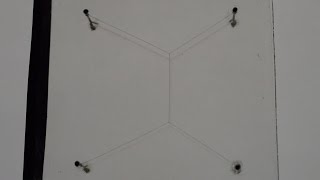
Steiner Tree Problem
Connect given points with the shortest possible network, allowing extra junction points.
The geometric Steiner tree problem asks for the shortest network connecting prescribed terminals, with optional Steiner points that meet at 120-degree angles. Its computational versions are NP-hard, but the visual principle is crisp.
Formula
Find the shortest tree interconnecting a given set of terminal points, allowing additional Steiner points.
In the Euclidean plane, a Steiner tree is at least √3/2 times the minimum spanning tree length (Gilbert–Pollak, proved 1990s).
Optimal Steiner points have degree 3 with equal 120° angles — the same geometry as soap film junctions (Plateau's laws).
Summary
The geometric Steiner tree problem asks for the shortest network connecting prescribed terminals, with optional Steiner points that meet at 120-degree angles. Its computational versions are NP-hard, but the visual principle is crisp.