Square Peg Problem
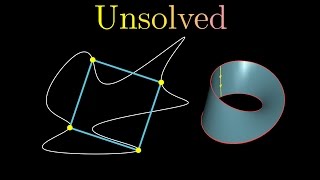
Every simple closed curve in the plane is conjectured to contain four vertices of a square.
Draw any closed loop on paper — no matter how wild. Can you always find four points on it forming a perfect square? Toeplitz conjectured yes in 1911, and partial results cover convex, smooth, and piecewise-linear curves. The most dramatic recent progress came from Greene and Lobb (2021), who used symplectic geometry — Möbius bands in R⁴ forming a Klein bottle — to prove every smooth curve inscribes rectangles of every aspect ratio. The general case for non-smooth Jordan curves remains open.
Formula
Every Jordan curve in the plane inscribes a square — open in full generality, proved for smooth and piecewise-linear curves.
For smooth curves the result follows from topological arguments; the difficulty is purely continuous curves with bad local behavior.
Greene–Lobb (2021) proved every smooth Jordan curve inscribes rectangles of every aspect ratio, using symplectic geometry.
Summary
Draw any closed loop on paper — no matter how wild. Can you always find four points on it forming a perfect square? Toeplitz conjectured yes in 1911, and partial results cover convex, smooth, and piecewise-linear curves. The most dramatic recent progress came from Greene and Lobb (2021), who used symplectic geometry — Möbius bands in R⁴ forming a Klein bottle — to prove every smooth curve inscribes rectangles of every aspect ratio. The general case for non-smooth Jordan curves remains open.