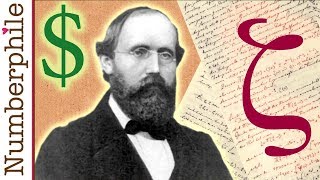
Riemann Hypothesis
All nontrivial zeros of the zeta function should lie on the critical line Re(s) = 1/2.
The Riemann Hypothesis asserts that every nontrivial zero of the analytic continuation of the Riemann zeta function has real part exactly 1/2. It is the central open problem in analytic number theory because it controls the error term in the prime-counting function: if true, the deviation of pi(x) from the logarithmic integral li(x) is at most of order sqrt(x) log x. Listed as the eighth of Hilbert's 1900 problems and one of the seven Clay Millennium Prize Problems, it connects to random matrix theory, quantum chaos, and the explicit distribution of primes through Riemann's 1859 explicit formula.
Formula
All nontrivial zeros of the Riemann zeta function should lie on the critical line Re(s) = 1/2.
The Euler product connects the zeta function directly to the prime numbers, linking analysis to arithmetic.
If the Riemann Hypothesis is true, the prime counting function pi(x) deviates from the logarithmic integral by at most order sqrt(x) log x.
Summary
The Riemann Hypothesis asserts that every nontrivial zero of the analytic continuation of the Riemann zeta function has real part exactly 1/2. It is the central open problem in analytic number theory because it controls the error term in the prime-counting function: if true, the deviation of pi(x) from the logarithmic integral li(x) is at most of order sqrt(x) log x. Listed as the eighth of Hilbert's 1900 problems and one of the seven Clay Millennium Prize Problems, it connects to random matrix theory, quantum chaos, and the explicit distribution of primes through Riemann's 1859 explicit formula.