Plateau's Problem
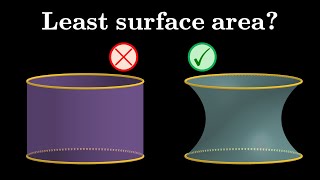
Find a surface of least area spanning a given boundary curve.
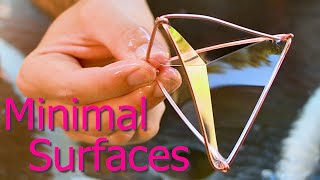
Dip a wire frame into soapy water — the film that forms minimises surface area, producing a minimal surface with mean curvature H = 0. Douglas and Radó independently proved existence in 1930–1931, earning Douglas one of the first Fields Medals. Federer–Fleming's geometric measure theory (1960) generalised the result to arbitrary dimensions via integral currents.
Formula
A surface spanning a given boundary wire minimizes area if and only if its mean curvature vanishes everywhere.
The average of the two principal curvatures vanishes on a minimal surface — the Euler–Lagrange equation for the area functional.
Douglas (1931) and Radó (1930) independently proved existence of a minimal disk spanning any rectifiable Jordan curve.
Summary
Dip a wire frame into soapy water — the film that forms minimises surface area, producing a minimal surface with mean curvature H = 0. Douglas and Radó independently proved existence in 1930–1931, earning Douglas one of the first Fields Medals. Federer–Fleming's geometric measure theory (1960) generalised the result to arbitrary dimensions via integral currents.