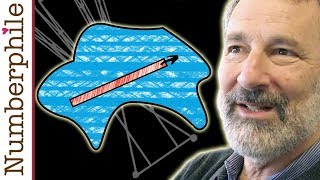
Kakeya Conjecture (2D)
A planar set can contain a unit segment in every direction and have area zero, but its Hausdorff dimension is still 2.
The planar Kakeya problem is the cleanest entry point to the whole Kakeya family. Besicovitch showed that a needle can point in every direction inside sets of arbitrarily small area, even measure zero. Davies proved the two-dimensional Kakeya dimension statement: every planar Besicovitch set still has full Hausdorff dimension 2.
Formula
A Besicovitch set in the plane has full Hausdorff dimension — proved by Davies in 1971.
Besicovitch (1919) showed Kakeya sets can have arbitrarily small Lebesgue measure, despite containing all directions.
A standard normalized form of the directional maximal estimate; it controls directions on the sphere and implies the Kakeya dimension conjecture.
Summary
The planar Kakeya problem is the cleanest entry point to the whole Kakeya family. Besicovitch showed that a needle can point in every direction inside sets of arbitrarily small area, even measure zero. Davies proved the two-dimensional Kakeya dimension statement: every planar Besicovitch set still has full Hausdorff dimension 2.