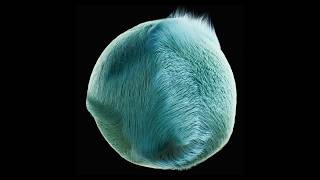
Hairy Ball Theorem
Every continuous tangent vector field on an even-dimensional sphere must vanish somewhere.
You cannot comb the hair on a coconut flat without creating a cowlick. More precisely, every continuous tangent vector field on S² must have a zero — a consequence of the Euler characteristic χ(S²) = 2 ≠ 0. Via the Poincaré–Hopf index theorem, the indices at all zeros must sum to χ, so the obstruction is purely topological. The result generalizes to all even-dimensional spheres S²ⁿ.
Formula
Every continuous tangent vector field on an even-dimensional sphere must vanish at some point.
The sum of the indices at all isolated zeros of a vector field equals the Euler characteristic of the manifold.
Since χ(S²ⁿ) = 2 ≠ 0, no non-vanishing tangent vector field can exist. Odd-dimensional spheres have χ = 0 and do admit one.
Summary
You cannot comb the hair on a coconut flat without creating a cowlick. More precisely, every continuous tangent vector field on S² must have a zero — a consequence of the Euler characteristic χ(S²) = 2 ≠ 0. Via the Poincaré–Hopf index theorem, the indices at all zeros must sum to χ, so the obstruction is purely topological. The result generalizes to all even-dimensional spheres S²ⁿ.