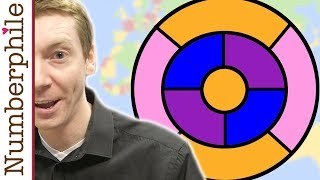
Four Color Theorem
Every planar map can be colored with at most four colors so neighboring regions differ.
The four color theorem is one of the clearest visual problems in mathematics: no matter how complicated a planar map becomes, four colors suffice. Appel and Haken's proof was the first major computer-assisted proof to settle a famous problem.
Formula
Every planar graph is 4-colorable — equivalently, every map on the plane or sphere can be colored with four colors.
The structural backbone: for any connected planar graph, vertices minus edges plus faces equals 2.
Every planar graph has a vertex of degree ≤ 5 (from Euler's formula). Appel–Haken's proof uses 1,482 reducible configurations.
Summary
The four color theorem is one of the clearest visual problems in mathematics: no matter how complicated a planar map becomes, four colors suffice. Appel and Haken's proof was the first major computer-assisted proof to settle a famous problem.