Faltings Abel Prize 2026
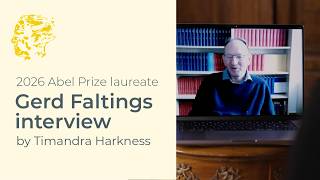
Gerd Faltings received the 2026 Abel Prize for arithmetic geometry and long-standing Diophantine conjectures.
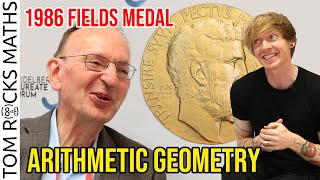
Gerd Faltings (born 1954) proved in 1983 that any algebraic curve of genus at least 2 defined over the rationals has only finitely many rational points, settling the Mordell conjecture that had been open since 1922. Subsequent simplifications came from Paul Vojta (1991) using Diophantine approximation and Enrico Bombieri (1990) with a more elementary variant. Faltings' broader contributions to arithmetic geometry, including the proof of the Mordell-Lang conjecture and the Tate conjecture for abelian varieties, earned him the Fields Medal in 1986 and the 2026 Abel Prize, cited for introducing powerful tools in arithmetic geometry and resolving long-standing Diophantine conjectures.
Formula
A smooth projective curve of genus ≥ 2 over Q has only finitely many rational points.
Faltings bounded the height of abelian varieties with good reduction outside S, proving the Shafarevich and Tate conjectures.
The ℓ-adic Tate module functor is fully faithful — proved by Faltings as a key step toward Mordell.
Summary
Gerd Faltings (born 1954) proved in 1983 that any algebraic curve of genus at least 2 defined over the rationals has only finitely many rational points, settling the Mordell conjecture that had been open since 1922. Subsequent simplifications came from Paul Vojta (1991) using Diophantine approximation and Enrico Bombieri (1990) with a more elementary variant. Faltings' broader contributions to arithmetic geometry, including the proof of the Mordell-Lang conjecture and the Tate conjecture for abelian varieties, earned him the Fields Medal in 1986 and the 2026 Abel Prize, cited for introducing powerful tools in arithmetic geometry and resolving long-standing Diophantine conjectures.