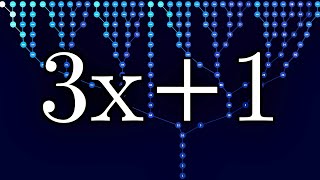
Collatz Conjecture
Repeatedly apply n/2 for even n and 3n+1 for odd n; every path should reach 1.
The Collatz conjecture, also known as the 3n+1 problem or the Syracuse problem, states that iterating the map T(n) = n/2 for even n and T(n) = 3n+1 for odd n will eventually reach the cycle 4 -> 2 -> 1 starting from any positive integer. Despite its elementary statement, Paul Erdos remarked that 'mathematics may not be ready for such problems.' In 2019, Terence Tao proved the strongest partial result to date: almost all orbits (in the sense of logarithmic density) attain almost bounded values. The conjecture has been computationally verified for all integers up to roughly 2.95 * 10^20.
Formula
The Collatz map divides even numbers by 2 and sends odd numbers to 3n+1.
Every positive integer eventually reaches 1 under repeated application of the Collatz map.
Almost all orbits (in logarithmic density) attain values below any function f(n) that diverges to infinity.
Summary
The Collatz conjecture, also known as the 3n+1 problem or the Syracuse problem, states that iterating the map T(n) = n/2 for even n and T(n) = 3n+1 for odd n will eventually reach the cycle 4 -> 2 -> 1 starting from any positive integer. Despite its elementary statement, Paul Erdos remarked that 'mathematics may not be ready for such problems.' In 2019, Terence Tao proved the strongest partial result to date: almost all orbits (in the sense of logarithmic density) attain almost bounded values. The conjecture has been computationally verified for all integers up to roughly 2.95 * 10^20.