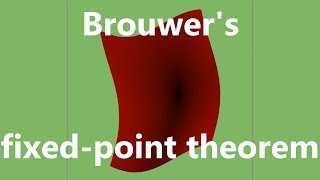
Brouwer Fixed Point Theorem
Every continuous map from a closed ball to itself has at least one fixed point.
Stir your coffee however you like — at least one molecule returns to where it started. Brouwer's theorem says every continuous self-map of Dⁿ has a fixed point. Equivalently, there is no continuous retraction from the ball onto its boundary. The Lefschetz number of any such map is 1 ≠ 0, forcing a fixed point purely by topology. Kakutani's 1941 extension to set-valued maps gave Nash the tool to prove that every finite game has an equilibrium.
Formula
Every continuous self-map of the closed unit ball has at least one fixed point.
If a fixed-point-free map existed, the ray from f(x) through x would define a retraction — but no such retraction can exist.
Since Dⁿ is contractible, Λ_f = 1 for every self-map. The Lefschetz theorem then guarantees a fixed point.
Summary
Stir your coffee however you like — at least one molecule returns to where it started. Brouwer's theorem says every continuous self-map of Dⁿ has a fixed point. Equivalently, there is no continuous retraction from the ball onto its boundary. The Lefschetz number of any such map is 1 ≠ 0, forcing a fixed point purely by topology. Kakutani's 1941 extension to set-valued maps gave Nash the tool to prove that every finite game has an equilibrium.