Borsuk–Ulam Theorem
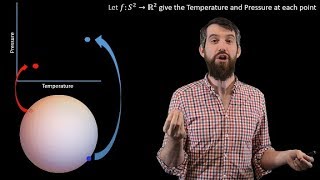
Every continuous map from a sphere to a plane identifies some pair of antipodal points.
At every instant, two diametrically opposite points on Earth share the same temperature and barometric pressure. Formally, every continuous f: Sⁿ → Rⁿ satisfies f(x) = f(−x) for some x. The proof rests on the algebraic topology of the ℤ/2-action on spheres: no continuous antipodal-preserving map Sⁿ → Sⁿ⁻¹ can exist. The theorem unifies results from the ham sandwich theorem to Tucker's lemma, making it one of the most widely applied tools in topological combinatorics.
Formula
Every continuous map from the n-sphere to Rⁿ identifies some pair of antipodal points.
There is no continuous antipodal map from Sⁿ to Sⁿ⁻¹ — equivalent to Borsuk–Ulam via normalization.
Any odd map from Sⁿ to Sⁿ has odd degree — the algebraic-topology engine behind Borsuk–Ulam.
Summary
At every instant, two diametrically opposite points on Earth share the same temperature and barometric pressure. Formally, every continuous f: Sⁿ → Rⁿ satisfies f(x) = f(−x) for some x. The proof rests on the algebraic topology of the ℤ/2-action on spheres: no continuous antipodal-preserving map Sⁿ → Sⁿ⁻¹ can exist. The theorem unifies results from the ham sandwich theorem to Tucker's lemma, making it one of the most widely applied tools in topological combinatorics.