abc Conjecture
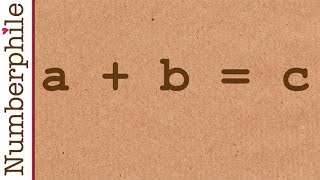
Controls how often a + b = c can have c much larger than the radical of abc.
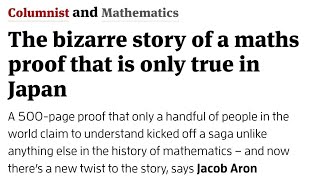
The abc conjecture, formulated independently by Joseph Oesterle and David Masser in 1985, states that for coprime positive integers with a + b = c, the value of c is almost always bounded by a power of the radical rad(abc) -- the product of distinct prime factors of abc. Despite its compact statement, it implies Fermat's Last Theorem for sufficiently large exponents, the Mordell conjecture, and many other deep results. In August 2012, Shinichi Mochizuki of Kyoto University released a claimed proof via inter-universal Teichmuller theory; however, after Peter Scholze and Jakob Stix identified a disputed step in 2018, the mathematical community remains unconvinced.
Formula
For every epsilon > 0 there are only finitely many coprime triples (a,b,c) with a+b=c violating this bound.
The radical of n is the product of its distinct prime factors, stripping away all repeated factors.
The abc conjecture implies Fermat's Last Theorem for all exponents n >= 6, illustrating its sweeping power.
Summary
The abc conjecture, formulated independently by Joseph Oesterle and David Masser in 1985, states that for coprime positive integers with a + b = c, the value of c is almost always bounded by a power of the radical rad(abc) -- the product of distinct prime factors of abc. Despite its compact statement, it implies Fermat's Last Theorem for sufficiently large exponents, the Mordell conjecture, and many other deep results. In August 2012, Shinichi Mochizuki of Kyoto University released a claimed proof via inter-universal Teichmuller theory; however, after Peter Scholze and Jakob Stix identified a disputed step in 2018, the mathematical community remains unconvinced.